
Most businesses that use a professional cleaning company sign a commercial cleaning contract at the start and rarely look at it again until something goes wrong. A cleaner fails to turn up. Standards slip. A price increase arrives without warning. And the business owner opens the contract to find out what their options are, often discovering that the document they signed does not protect them as well as they assumed.
A well-structured commercial cleaning contract is not a formality. It is the document that defines what you are paying for, how performance will be measured, what happens when it is not delivered, and how you exit the arrangement if you need to. Getting it right from the start saves money, reduces disruption, and gives you real leverage when things do not go to plan.
Here is what every commercial cleaning contract should include…

What Is a Commercial Cleaning Contract?
A commercial cleaning contract is a formal agreement between a business and a professional cleaning company that sets out the scope of work, frequency of service, pricing, and the terms under which both parties operate. It applies to any commercial premises where cleaning is provided on a regular, contracted basis: offices, retail units, industrial buildings, schools, healthcare premises, housing association schemes, and more.
The contract is distinct from a one-off or ad hoc cleaning quote. It establishes an ongoing relationship and, critically, the obligations of both parties within it.
What Should a Commercial Cleaning Contract Include?
A thorough commercial cleaning contract should cover all of the following.
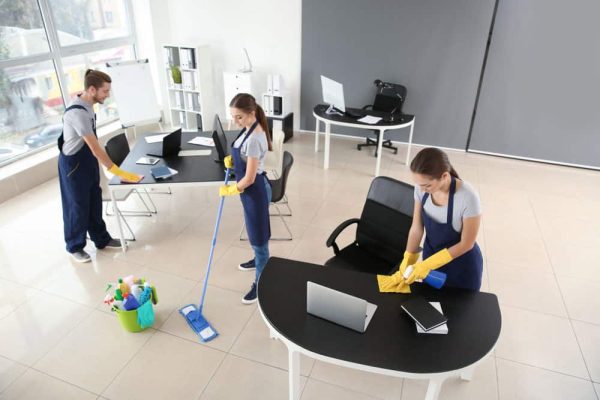
Scope of work. The contract should list every area to be cleaned, the tasks to be carried out in each area, and the standard to which they should be completed. Vague language such as “general office cleaning” is not sufficient. A well-drafted scope of work specifies which rooms, surfaces, floors, and facilities are covered, and which are excluded.
Cleaning frequency and schedule. The contract should confirm how often cleaning will take place, on which days, and during which hours. Where different areas require different frequencies, such as daily washroom cleaning versus weekly carpet vacuuming, these should be listed separately. Ad hoc or periodic tasks, such as window cleaning or deep cleans, should be documented alongside the regular schedule rather than left to informal agreement.
Staffing, supervision and DBS checks. The contract should confirm who is responsible for managing the cleaning team, how supervision is provided, and whether staff have undergone Disclosure and Barring Service (DBS) checks. For premises handling sensitive information or serving vulnerable people, this is not optional.
Products, equipment and COSHH compliance. All cleaning chemicals used on your premises must comply with the Control of Substances Hazardous to Health (COSHH) regulations. The contract should confirm that the contractor maintains COSHH data sheets for all products used, that staff have received appropriate training, and whether products and equipment are supplied by the contractor or the client.
Insurance and liability. Your contractor should carry adequate public liability insurance and employers’ liability insurance. The contract should state the minimum cover levels and confirm that these will be maintained throughout the agreement. If damage is caused to your premises during cleaning, the insurance and liability clauses determine how that is resolved.
Key performance indicators and quality standards. A contract that lacks measurable standards gives you no basis for raising a formal complaint. Quality indicators might include inspection frequencies, audit processes, response times for rectifying substandard work, and reference to professional bodies such as the British Institute of Cleaning Science (BICSc), whose standards are widely used across the UK contract cleaning industry.
Price review mechanisms. The contract should state the agreed price, when and how it can be reviewed, and what notice must be given before any increase takes effect. A contract that allows a contractor to increase prices without restriction or adequate notice is a significant commercial risk.
Notice periods and exit clauses. Both parties should have a defined right to terminate the contract with reasonable notice, and the contract should specify what that notice period is. Industry standard for commercial cleaning contracts is typically one to three months, depending on contract size. You should also check whether there are penalty clauses for early exit, and whether the exit terms are broadly symmetrical for both parties.
TUPE obligations. If you switch cleaning contractors, the staff currently cleaning your premises may be protected under TUPE regulations (Transfer of Undertakings, Protection of Employment). The GOV.UK guidance on TUPE specifically cites cleaning as a service provision change to which TUPE applies. A reputable contractor will handle this process transparently, and your contract should confirm how staff transfers are managed when the arrangement changes.

What Should an Office Cleaning Contract Include?
Office cleaning contracts carry most of the same requirements as any commercial cleaning contract, but a few areas deserve particular attention in an office environment.
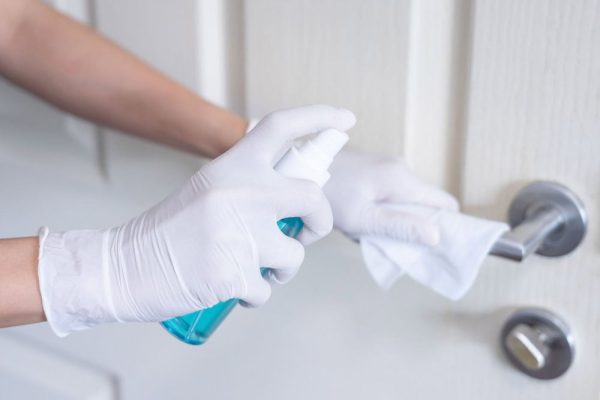
High-touch surface cleaning, including desk surfaces, door handles, lift buttons, and shared equipment, should be specified clearly rather than assumed. Washrooms, kitchen areas, and breakout spaces need their own cleaning frequencies documented separately from open-plan or private office areas. For businesses operating hybrid working patterns, the contract should reflect actual occupancy levels rather than a theoretical headcount.
Security arrangements also matter in office environments. Key-holding responsibilities, alarm access, out-of-hours procedures, and what happens when a cleaner is working on site unaccompanied should all be addressed in the contract or an accompanying operations document.
How Much Does a Commercial Cleaning Contract Cost?
Pricing for commercial cleaning contracts varies significantly depending on premises size, required frequency, scope of work, and location. Our separate guide covers this in detail, including what drives price differences and how to judge value before you sign: What Should Commercial Cleaning Cost in 2026?
What Should You Look for in a Commercial Cleaning Contract Template?
A commercial cleaning contract template can be a useful starting point, but it is rarely sufficient on its own. Generic templates tend to underspecify the scope of work, omit site-specific arrangements, and use standard notice and liability clauses that may not reflect the scale or sensitivity of your premises.
The value of a commercial cleaning contract lies in its specificity. A contractor that provides you with a generic document and asks you to sign it quickly is a different proposition from one that conducts a proper site survey, produces a written specification, and tailors the contract to your premises before you commit.
If you are reviewing a template, check that it covers all the areas listed above, and treat any significant omissions as a point of negotiation before signing.
Red Flags in a Commercial Cleaning Contract
Before signing any commercial cleaning contract, watch for the following.
No written scope of work. If the contract does not specify what is being cleaned and to what standard, there is no basis for holding the contractor accountable when performance falls short.
Unlimited price review rights. A clause that allows the contractor to increase prices at any time without defined notice is a commercial risk that should be renegotiated before signing.
No KPIs or audit process. Without measurable standards, poor performance becomes a matter of opinion rather than a documented breach of contract.
Exit terms that favour only one party. Short or no notice periods for the contractor, but long notice periods for you, is a structural imbalance worth challenging.
No reference to insurance cover levels. Confirm that the contractor carries adequate public liability and employers’ liability insurance before the contract begins, not after an incident.
Carter & Faraday: Commercial Cleaning Contracts in Surrey & Sussex
Carter & Faraday Associates have been providing commercial cleaning contracts across Sussex, Surrey, Kent, and South London since 1978. Every contract we provide includes a written scope of work, documented visit records, a named area supervisor, and a clear quality management process so that both parties understand exactly what has been agreed.
Whether you manage an office in Crawley or Horsham, a commercial portfolio in Guildford or Reigate, or a housing scheme across Redhill and the wider area, we can produce a written specification for your premises and take you through exactly what your cleaning service contract should contain before you sign anything.
We also provide grounds maintenance contracts, window cleaning, gutter clearing, and carpet and floor cleaning, which means a single contract and a single point of contact for the full range of services your premises requires.
See our guide to what a grounds maintenance contract should include >>
Get in touch with Carter & Faraday today
Or call us on 01444 482 666 to arrange a free site visit and no-obligation written specification.