
Cleaning a dental surgery is not the same as cleaning an office. The products are different, the protocols are different, and the consequences of getting it wrong are more serious. In a healthcare setting, inadequate cleaning is not just an aesthetic failure. It is an infection risk, a regulatory concern, and in CQC-registered practices, a compliance issue that can result in formal action.
Healthcare cleaning services sit in a distinct category from standard commercial cleaning. They require staff trained in infection prevention and control, knowledge of which disinfectants are appropriate for which surfaces and settings, colour-coded equipment to prevent cross-contamination, and documented processes that can be evidenced if a practice is inspected.
This guide covers what clinical cleaning services for dental surgeries, GP practices, medical clinics, and veterinary practices actually involve, how to structure your cleaning programme, and what to look for when choosing a healthcare cleaning company in Surrey and Sussex.
Why Healthcare Cleaning Is Different
In most commercial environments, cleaning is primarily about presentation and basic hygiene. In healthcare settings, it is about infection prevention and control (IPC), and the two are not the same thing.
Healthcare premises operate on the understanding that patients and clients may be immunocompromised, recovering from procedures, or presenting with infectious conditions. The cleaning programme in any healthcare setting must reflect that. Surfaces need to be decontaminated, not just cleaned. Products need to have demonstrable bactericidal and virucidal efficacy, not just leave surfaces looking clean. And the cleaning process needs to be documented so that, in the event of an infection incident or a CQC inspection, there is a clear record of what was done and when.
The Care Quality Commission (CQC) regulates healthcare providers in England, including dental practices, GP surgeries, and many other clinical settings. Its fundamental standards include specific expectations around the cleanliness and hygiene of premises. A healthcare cleaning service that cannot demonstrate compliance with those expectations is not fit for purpose in a regulated healthcare environment.
Dental Surgery Cleaning: What It Involves
Dental surgery cleaning is one of the most technically demanding forms of clinical cleaning services. Dental practices operate across multiple zones, each with different cleaning requirements, and the standard is set by a combination of CQC expectations and the Health Technical Memorandum HTM 01-05, which covers decontamination in primary dental care.
Clinical areas (surgeries and treatment rooms) require the highest level of decontamination. Dental chairs, unit surfaces, bracket tables, light handles, and any surface that may have been in contact with patient fluids or aerosols must be decontaminated between patients using an appropriate disinfectant. End-of-day cleans go further, addressing floors, walls where splatter may have occurred, and all surfaces with appropriate dwell times.
Decontamination rooms are specialist spaces and must be kept to a clinical standard throughout the working day. The cleaning approach here needs to reflect the nature of the instruments being processed in the room.
Waiting rooms and reception areas are lower-risk zones but still require a cleaning standard above that of a standard commercial environment. High-touch surfaces including door handles, chairs, and reception counters carry significant cross-contamination risk given the patient population moving through them.
Staff areas and toilets require standard commercial cleaning standards, with appropriate products used in washroom areas.
A professional dental surgery cleaning service will have operatives trained in these zone distinctions and the correct product and equipment protocols for each.
GP Surgery and Medical Practice Cleaning
GP surgery cleaning presents a similar challenge to dental settings: a high-footfall, patient-facing environment with a mixed and sometimes vulnerable population, regulated by the CQC, and requiring documented cleaning standards.
Treatment rooms, consulting rooms, and clinical areas require decontamination-standard cleaning at the end of each working day and, where spillages or clinical contact occurs, immediately. Examination couches, trolleys, and any clinical equipment surfaces must be cleaned with appropriate disinfectants.
Waiting rooms in medical practice cleaning contexts require particular attention to high-touch surfaces: chairs, door handles, reception screens, and touch-point panels. The patient population in a GP surgery includes people who are unwell and potentially infectious, making the waiting room one of the higher-risk areas for surface-to-patient transmission in any practice.
For GP surgery cleaning services, frequency and consistency are as important as the standard of any individual clean. A practice that is thoroughly cleaned three times a week but only superficially maintained between visits does not meet the standard that CQC expects to see maintained across the working week.
What Do Professional Healthcare Cleaning Services Include?
A professional healthcare cleaning service covers considerably more than a standard commercial clean. Here is what a thorough programme should address:
Clinical and treatment areas.
Decontamination of all surfaces with appropriate bactericidal and virucidal products. Colour-coded cloths and mops used to prevent cross-contamination between clinical and non-clinical zones. Floors mopped and disinfected. Clinical waste handled correctly and areas cleaned after disposal.
Waiting rooms and reception.
All high-touch surfaces disinfected. Chairs wiped down. Reception desks and screens cleaned. Entrance glass and door furniture disinfected. Floors swept and mopped.
Washrooms and toilets.
Cleaned and disinfected to the same standard as any commercial washroom, with appropriate bactericidal products used on all surfaces and fixtures. Consumables restocked.
Staff areas and kitchens.
Standard commercial cleaning with particular attention to shared surfaces and appliances.
Documentation.
Every visit should be logged. A reputable clinical cleaning service will provide records of what was cleaned, when, and by whom. In a CQC-regulated setting, this documentation is not optional.
Colour-coded equipment.
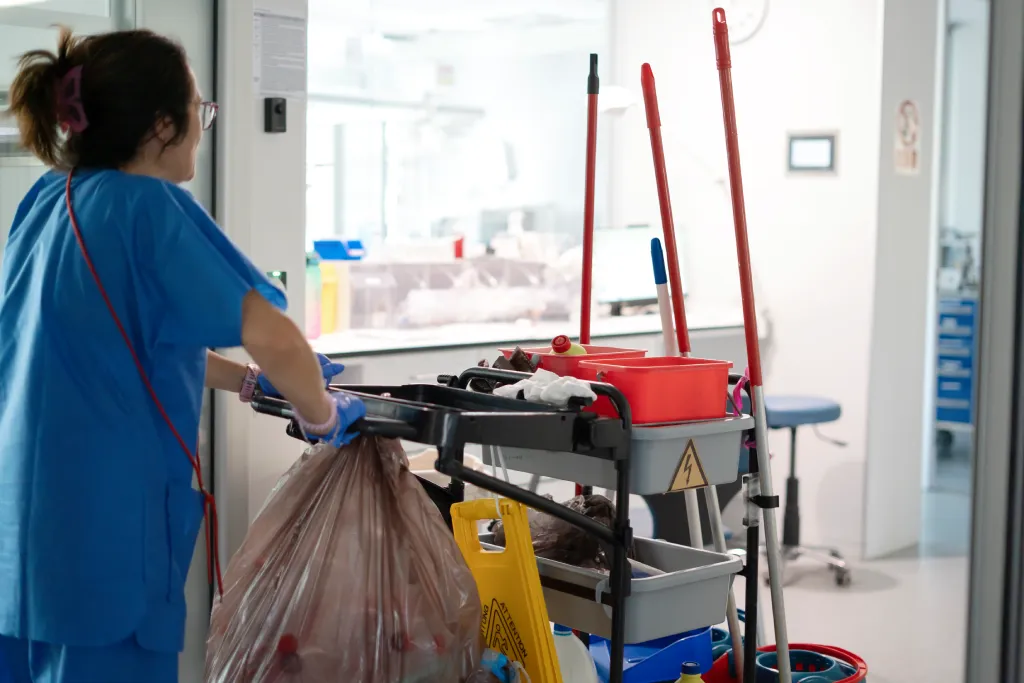
Cross-contamination between clinical and non-clinical zones is one of the primary risks in any healthcare cleaning programme. Professional healthcare cleaning services use colour-coded cloths, mops, and buckets to ensure that equipment used in clinical areas is never used elsewhere.
How Often Should Healthcare Premises Be Cleaned?
The right frequency for healthcare cleaning services depends on the type of practice, the volume of patients, and the nature of the clinical work being carried out.
Daily cleaning is the baseline standard for all CQC-regulated premises, covering clinical areas, waiting rooms, reception, washrooms, and high-touch surfaces throughout the building.
Between-session or between-patient cleaning of clinical areas is the responsibility of clinical staff and falls outside the scope of a contract cleaning programme. However, the end-of-session or end-of-day clean carried out by a professional dental surgery cleaning company should go considerably further than the routine wipe-down carried out between appointments.
Periodic deep cleans should be scheduled at least quarterly for most healthcare premises. These address areas not reached in daily cleaning: grout lines in clinical flooring, extractor vents, high-level surfaces, and the fabric of waiting room furniture.
After infection incidents or patient notifications. Any confirmed infection incident involving a pathogen of concern may warrant an unscheduled deep clean of the affected areas, using appropriate products and with a documented record of the work carried out.
Choosing a Healthcare Cleaning Company
When searching for healthcare cleaning services near me in Surrey or Sussex, the considerations are different from those involved in choosing a standard office cleaning contractor. Look for:
Training in infection prevention and control.
Operatives should have specific training in IPC principles, not just general commercial cleaning. Ask what training your team will receive and how it is kept up to date.
Knowledge of appropriate products.
A healthcare cleaning company should be able to tell you which disinfectants they use, what their bactericidal and virucidal claims are, and why those products are appropriate for a healthcare environment. General-purpose surface sprays are not adequate for clinical zones.
Colour-coded equipment as standard.
This is non-negotiable in a regulated healthcare setting. If a contractor does not operate a colour-coded system, they should not be cleaning a dental surgery or GP practice.
Documentation and reporting.
Cleaning logs, visit records, and a clear escalation process are essential in a CQC-regulated environment.
Flexible scheduling.
Healthcare premises operate to clinical timetables. Your cleaning contractor needs to be able to work around appointment schedules, out of hours where required, and respond quickly when an unscheduled clean is needed.
Background-checked operatives.
Any contractor working in a healthcare environment should carry out appropriate background checks on all operatives, particularly in settings where vulnerable patients may be present.
Carter & Faraday: Healthcare Cleaning Services in Surrey & Sussex
Carter & Faraday have been providing healthcare cleaning services to dental surgeries, medical practices, and clinical settings across Sussex, Surrey, Kent, and South London since 1978. Our teams have specialist knowledge of the cleaning chemicals and protocols appropriate for healthcare environments, and our approach is tailored to the specific requirements of each setting, not adapted from a standard commercial template.
We provide written specifications on every contract, documented visit records, colour-coded equipment as standard, and a dedicated area supervisor accountable for the standard of every clean. All operatives are fully trained, insured, and background-checked where the setting requires it. We hold ISO 9001 and ISO 14001 accreditation, and our flexible scheduling means we can work around your clinical timetable without disrupting patient-facing operations.
Whether you manage a dental surgery cleaning programme in Horsham or Reigate, a GP surgery cleaning contract in Crawley or Guildford, or a medical clinic requiring clinical cleaning services across Sussex and Surrey, we would be glad to discuss what a properly structured healthcare cleaning programme looks like for your practice.
Get in touch with Carter & Faraday today
Contact us or call us on 01444 482 666.
We have been looking after healthcare and commercial premises across the South East for over 45 years.